01Full Stack Platform

Case study · Web platform

Wedding Invitation Platform

Personal invitations, RSVP, guest management, an administration interface, and integrations within one system.

  • Full stack development
  • Responsive web application
  • Guest management
  • Integrations
  • Production deployment
Guest experiencePrivacy-reviewed selection
Desktop guest navigation across the wedding platform sections01 · Desktop guide
Mobile guide interface for the wedding platform02 · Mobile flow
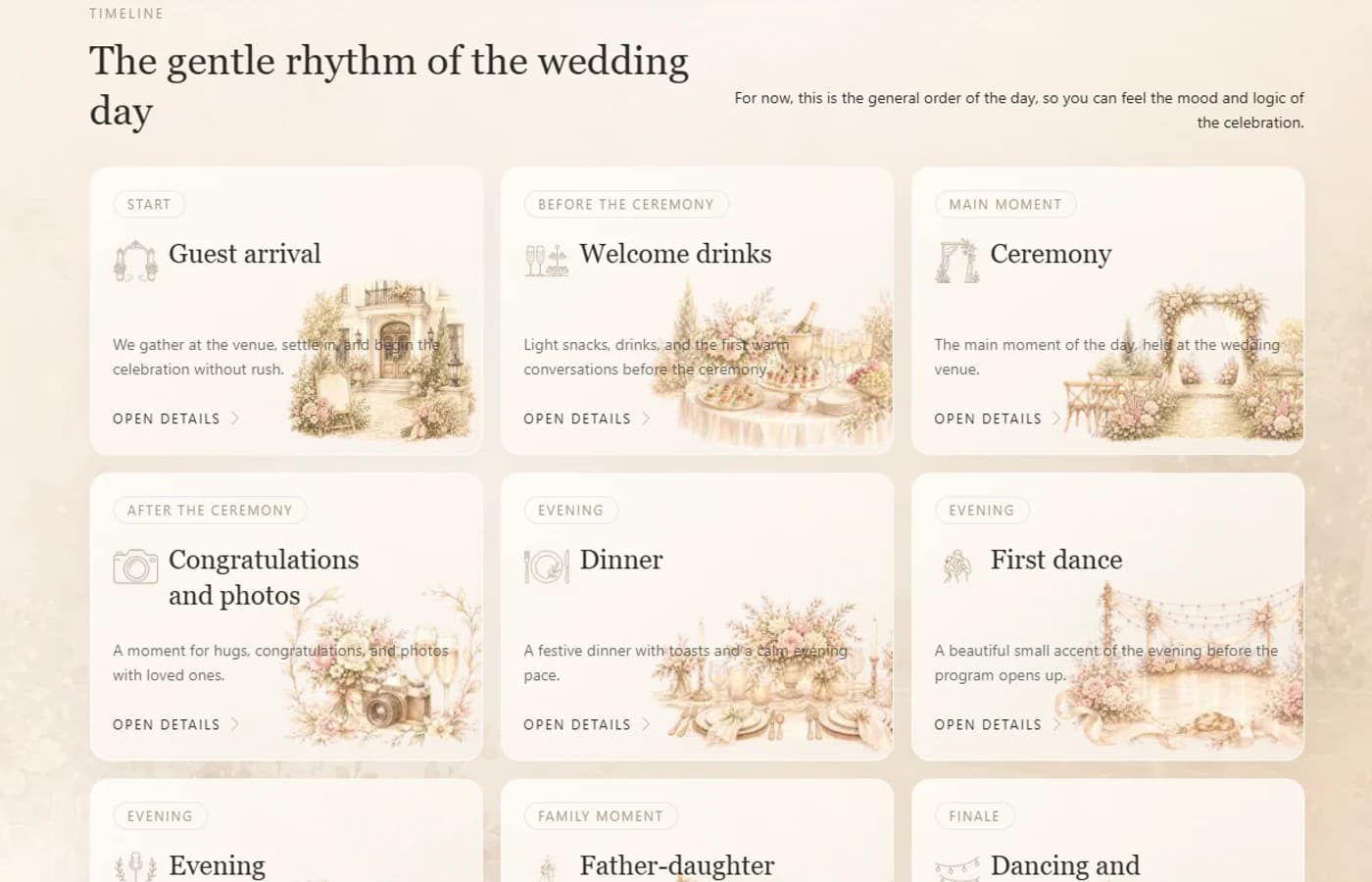
Wedding-day program cards in the guest interface03 · Day program
The real guest experience across desktop, mobile, and the day program — without personal data or invitation parameters.

Project summary

Product type
Personalized web platform
Primary users
Event guests and administrators
Format
Responsive web application
Role
Product design, frontend, backend, integrations, and deployment
Status
Working production project

01 · Initial problem

Connect invitations and responses

The challenge was to move personal invitations and guest responses from fragmented manual operations into one manageable product workflow.

Before

  • Personal invitations created manually
  • Responses collected across separate channels
  • Different guests require different content
  • Statuses require manual control

After

  • Personal page
  • RSVP
  • Centralized data
  • Administration control
  • Integration workflows

02 · User journeys

Two distinct working contexts

Guest

Invited user

  1. 01

    Invite link

  2. 02

    Personal page

  3. 03

    Program and details

  4. 04

    RSVP

  5. 05

    Additional information

Administrator

Event organizer

  1. 01

    Create invitation

  2. 02

    Manage guest

  3. 03

    Track RSVP

  4. 04

    Import / export

  5. 05

    Communication integrations

03 · Product layers

Five connected system layers

  1. 01

    Experience

    Personal guest pages and administration workflows.

    • Guest journey
    • RSVP forms
    • Admin workflows
  2. 02

    Application

    Server-side logic, rules, and API contracts.

    • Next.js application
    • API routes
    • Validation
  3. 03

    Data

    Centralized invitation and response state.

    • PostgreSQL
    • SQL migrations
    • Import / export
  4. 04

    Integrations

    Separated external access and communication channels.

    • Telegram
    • VK
    • Discord
  5. 05

    Delivery

    Build pipeline, production runtime, and operational checks.

    • CI/CD
    • VPS
    • Nginx
    • Health checks

01

Personal pages

Each invitation becomes a responsive journey containing information relevant to a specific guest.

02

RSVP

Guest responses are processed on the server and stored centrally so organizers can see the current status.

03

Administration interface

The operational workspace connects invitation, guest, and response management without relying on disconnected spreadsheets.

04

Integrations

Telegram, VK, and Discord support selected confirmation, access, and communication scenarios.

04 · Architecture

One application, separated workflows

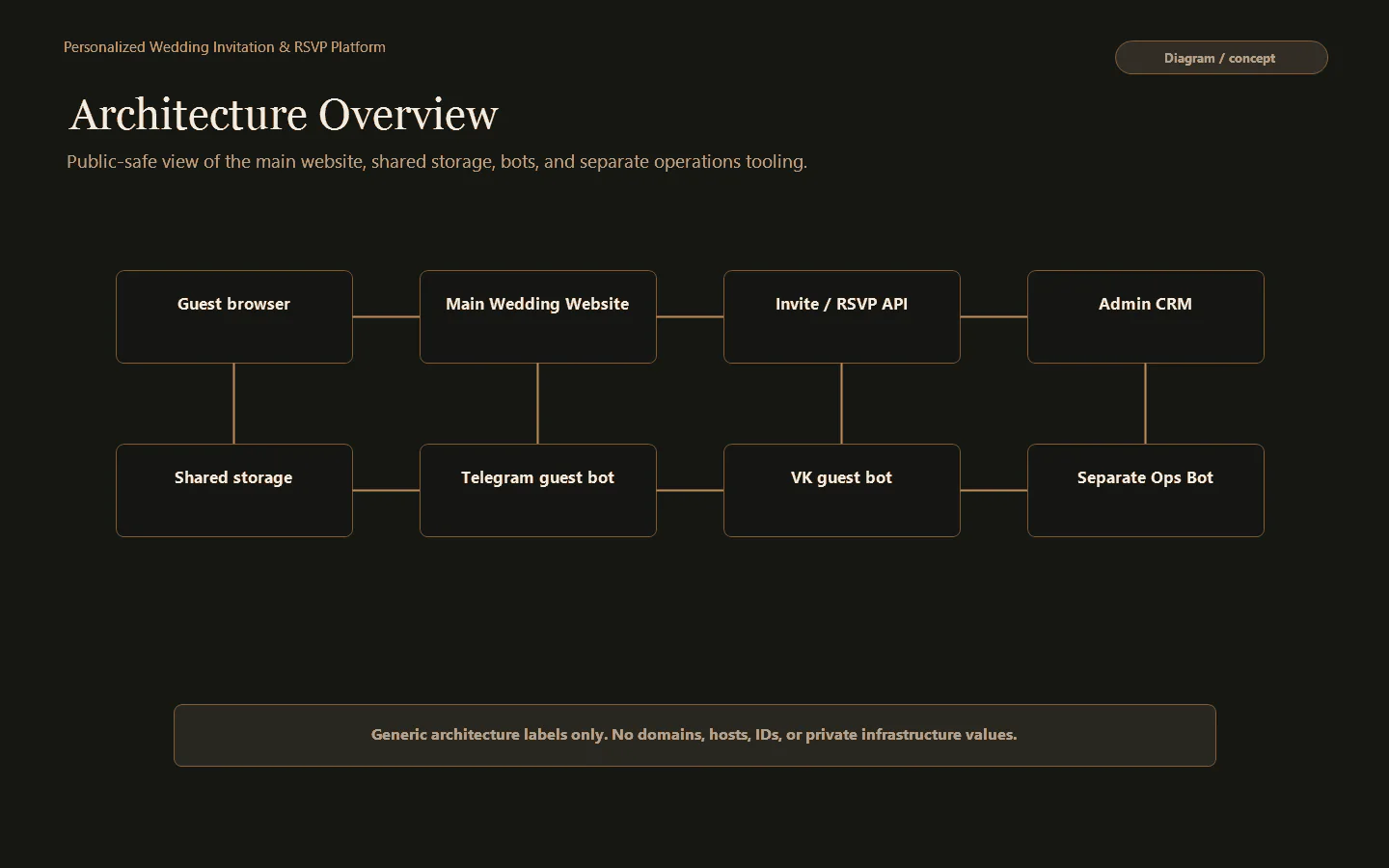
The platform is delivered as one Next.js application. App Router connects guest pages, administration workflows, and server routes, while PostgreSQL stores centralized state.

Privacy-reviewed diagramArchitecture
Dark Wedding Invitation Platform architecture diagram showing the guest interface, API, storage, administration boundary, and integrations
A public overview of the platform boundaries without domains, identifiers, or private infrastructure parameters.
  1. 01Guest or administrator
  2. 02Next.js application
  3. 03Server logic and API
  4. 04PostgreSQL
  5. 05External integrations
  • Guest and administration flows are separated in both the interface and server logic.
  • API and server-side handlers validate data, change states, and coordinate persistence.
  • External integrations operate as a separate boundary without exposing internal contracts.

05 · Frontend

Guest-first on mobile, efficient admin on desktop

The guest interface was designed mobile-first, while administration workflows needed to remain efficient on desktop.

  • Next.js, React, and TypeScript for interfaces and application logic.
  • Tailwind CSS for responsive layout and a consistent visual system.
  • Individual invitation pages and RSVP forms.
  • Administration interfaces for operational workflows.
  • Restrained motion without compromising accessibility or content.

06 · Backend and data

Centralized server-side processing

The server handles RSVP, administration operations, and data access. Invitation and response states are stored centrally.

  • Next.js server-side logic and API routes.
  • PostgreSQL and SQL migrations.
  • Server-side validation and state control.
  • Guest and invitation data without publishing real records.
  • Import and export for administration operations.
  • Health and operational checks.

07 · Integrations

External channels without exposing contracts

Integrations support confirmation, access, and auxiliary communication scenarios.

  • Telegram
  • VK
  • Discord

Bot names, callback addresses, application identifiers, tokens, and internal webhook paths are intentionally withheld.

08 · Infrastructure and deployment

From implementation to production

The project was taken beyond implementation to a working production state with controlled deployment and operational checks.
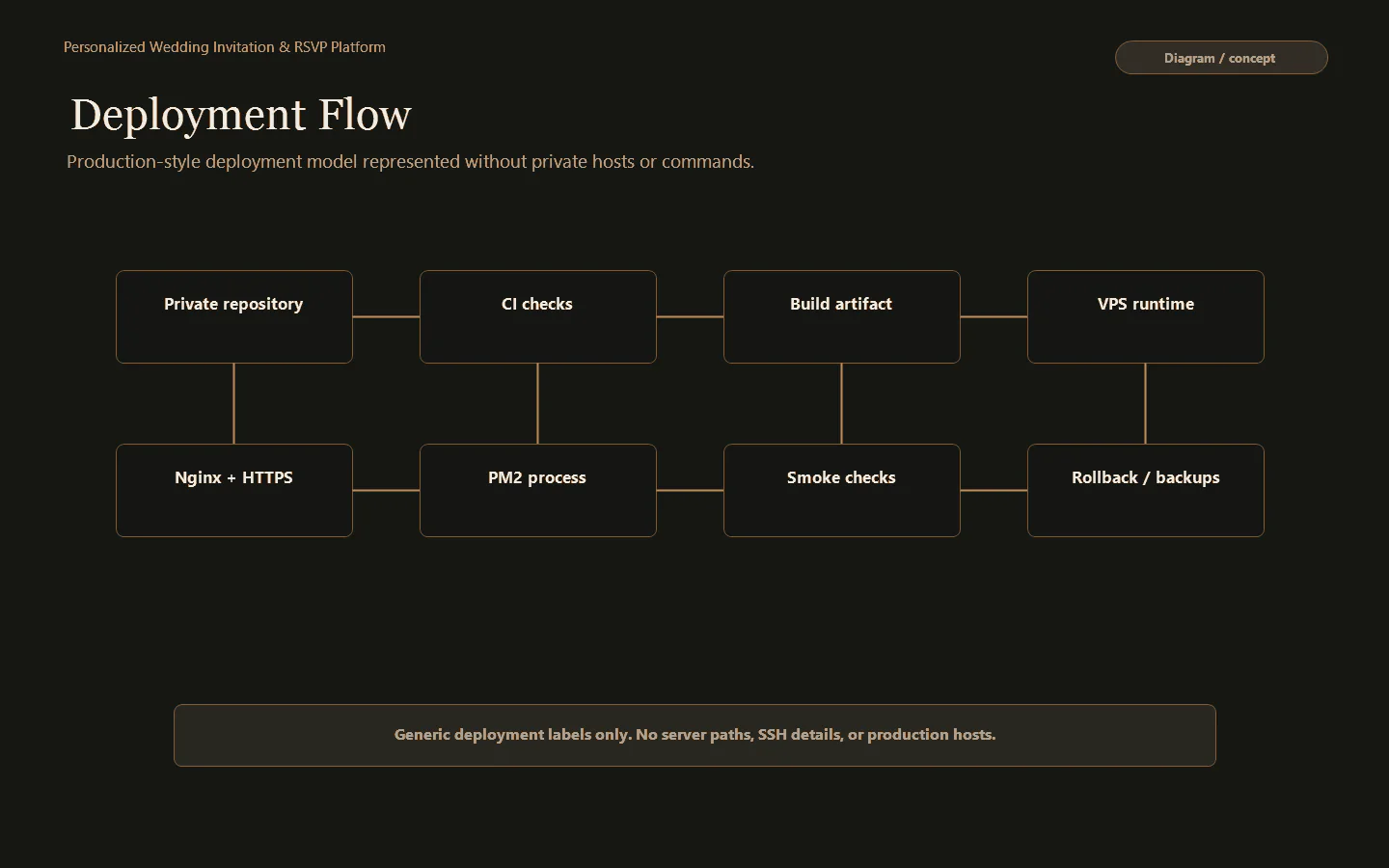
Privacy-reviewed diagramDelivery
Dark Wedding Invitation Platform build and deployment flow diagram
A generalized verification, build, launch, and recovery flow without server addresses or access commands.
  • VPS and Nginx for application hosting.
  • A process manager for the runtime process.
  • GitHub Actions and CI/CD for controlled deployment.
  • Health checks, diagnostics, and post-launch verification.
  • Recovery procedures prepared without publishing sensitive parameters.

09 · Role

Scope of responsibility

I was responsible for user flows, frontend development, server-side logic, data handling, integrations, and production infrastructure.

  1. 01

    Product thinking

    User flows and product boundaries.

  2. 02

    Frontend

    Guest and administration interfaces.

  3. 03

    Backend

    Server-side logic, API, and validation.

  4. 04

    Data

    Data model and operational workflows.

  5. 05

    Integrations

    Communication and access scenarios.

  6. 06

    Infrastructure

    Production runtime and deployment.

  7. 07

    Support

    Diagnostics and controlled evolution.

10 · Technology stack

Tools organized by system layer

Frontend

Guest and administration interfaces.

  • Next.js
  • React
  • TypeScript
  • Tailwind CSS
  • Framer Motion

Backend

Server logic and request processing.

  • Next.js server-side logic
  • API routes
  • Node.js
  • Server-side validation

Data

Centralized state and operational data flows.

  • PostgreSQL
  • SQL migrations
  • Import/export flows

Integrations

Supporting access and communication channels.

  • Telegram
  • VK
  • Discord

Infrastructure

Deployment and the operational environment.

  • VPS
  • Nginx
  • GitHub Actions
  • CI/CD
  • Health checks
  • Process management

12 · Product interfaces

Product interfaces

Four strong privacy-reviewed frames show the real desktop, mobile, day program, and dress-code surfaces without guest personal data.

04 · Privacy reviewed

The general flow of the day without the couple identity, date, venue, or private navigation context.
A mobile-first section card without a guest name, date, or invitation code.
Desktop guest experience: the general guide without the personalized hero.
The guest dress-code guide without names, date, location, or invitation parameters.

11 · Public boundaries

What is intentionally not published

The public case intentionally excludes guest personal data, real invitation links, administration records, integration configuration, and parts of the internal infrastructure.

  • Private source code is not published.
  • Uncropped guest and administration screens are excluded; only privacy-reviewed product crops are public.
  • Architecture images were sanitized and reviewed.
  • Selected interfaces may be shown privately with permission.

Navigation

Continue exploring the work