Full Stack · Backend · Infrastructure

I design and launch web systems for businesses

Frontend, backend, databases, automation, and infrastructure — handled as one connected system.

System architecture

One connected delivery scope

From the first user action to data, integrations, and production infrastructure.

ResponsibilityEnd-to-end delivery

Two perspectives · one ownership model

Clear for hiring. Credible for technical teams.

I enjoy technical problems and look at the product as a whole: from the user journey and API to data, infrastructure, launch, and support.

For HR and employers

A Full Stack developer for product and system work

A strong fit for roles that need independence, dependable delivery, and the ability to take work beyond a page or feature into a working system.

Roles and problems

  • Full Stack
  • Backend
  • Web products
  • Automation
  • Internal systems
  • Product delivery

Why consider me

I connect product context, implementation, and operations; I can work carefully inside existing systems and own outcomes end to end.

For founders, CTOs, and product teams

The engineering path from API to production

I design backend and data flows, integrations, and infrastructure while treating constraints, states, permissions, and operational risks as one product system.

Technical focus

  • Backend
  • API contracts
  • Data
  • Infrastructure
  • Integrations
  • Deployment
  • Support
  • System thinking

How I contribute

I can build a new system boundary, evolve an existing one safely, or own diagnosis, launch, and continued support.

01 · Business tasks

What I can help you build or improve

From a new product idea to the safe evolution of an existing system and a documented production setup.

01

Build a system from the ground up

Problem

There is an idea or a working process, but no usable digital product yet.

What I can build

  • MVP
  • Customer portal
  • Administration panel
  • Internal services
  • Request system

Technical scope

  • Interface
  • Backend
  • API
  • Database
  • Roles
  • Deployment

Outcome

A working system that can be tested, launched, and developed further.

Explore this stage

Examples

  • MVP
  • customer account
  • admin panel
  • request system

Possible scope

  • core user flow
  • roles and access
  • operations boundary
  • first production-ready release

What I need

  • product goal
  • users
  • current process
  • constraints and priorities

Technical implementation

  • responsive UI
  • backend/API
  • PostgreSQL
  • authentication
  • deployment

Stage result

  • testable working system
  • documented constraints
  • next-stage plan

Before estimation

  • what is the MVP
  • which roles are required
  • mandatory integrations
  • target hosting
02

Automate manual processes

Problem

Teams work across spreadsheets and chats while updating statuses by hand.

What can be automated

  • Requests and statuses
  • Staff allocation
  • Notifications
  • Reporting
  • Repeated operations

Technical scope

  • Business workflows
  • Roles
  • Validation
  • Integrations
  • Scheduled actions
  • Dashboards

Outcome

One manageable process instead of several disconnected tools.

Explore this stage

Examples

  • requests
  • staff assignment
  • statuses
  • notifications
  • reporting

Possible scope

  • one end-to-end workflow
  • exception rules
  • operations panel
  • action history

What I need

  • current manual process
  • participant roles
  • tables/forms
  • frequent errors and exceptions

Technical implementation

  • workflow states
  • RBAC
  • validation
  • notifications
  • reports

Stage result

  • one controlled process
  • fewer manual handoffs
  • clear statuses

Before estimation

  • mandatory steps
  • decision owners
  • source of truth
  • what must stay manual
03

Extend an existing product

Problem

The product is live, but it needs a new feature, integration, or technical correction.

Possible work

  • New feature
  • Backend or API
  • Authentication and roles
  • Integration
  • Performance
  • Architectural bottleneck

Approach

  • Initial audit
  • Isolated change scope
  • Compatibility
  • Scenario verification

Outcome

An isolated change or a controlled product evolution without an automatic full rewrite.

Explore this stage

Examples

  • new feature
  • integration
  • authentication
  • performance
  • technical defect

Possible scope

  • focused audit
  • isolated implementation
  • migration
  • regression checks

What I need

  • repository
  • reproduction scenario
  • architecture context
  • acceptance criteria

Technical implementation

  • compatible change
  • tests
  • observability
  • release notes

Stage result

  • verified change
  • preserved existing flows
  • explicit risk boundary

Before estimation

  • version and environment
  • legacy depth
  • available tests
  • data migration needs
04

Prepare the launch and infrastructure

Problem

The application is built, but it still needs a reliable build, deployment, and support process.

Technical scope

  • Linux and VPS
  • Docker
  • Nginx
  • PostgreSQL
  • CI/CD
  • HTTPS
  • Monitoring
  • Backups

Launch workflow

  • Build
  • Configuration
  • Smoke testing
  • Updates
  • Diagnostics

Outcome

A documented production process with a clear update and diagnostic path.

Explore this stage

Examples

  • VPS/Docker
  • managed platform
  • HTTPS
  • CI/CD
  • monitoring
  • backups

Possible scope

  • production topology
  • release pipeline
  • health checks
  • backup/restore
  • rollback

What I need

  • current build
  • target hosting
  • domains
  • budget constraints
  • recovery expectations

Technical implementation

  • build config
  • runtime config
  • reverse proxy
  • smoke checks
  • runbook

Stage result

  • repeatable launch
  • health visibility
  • clear updates and recovery

Before estimation

  • infrastructure owner
  • realistic SLA
  • data location
  • required owner checkpoints

02 · System examples

Examples of systems I can build

Implemented system types are separated from capabilities I can apply to a new product context.

Implemented

System types and delivery areas evidenced by the current projects.

Can build

Potential solutions, not claims that every item has a separate public case study.

01

Operations

Requests, staff, shifts, and controlled workflows.

Implemented

  • Shift management
  • Staff assignment

Can build

  • Request system
  • Reporting automation
Open structure

Examples

Shift management · Staff assignment · Request system · Reporting automation

Typical users

operator · manager · employee · team lead

Technical blocks

roles · workflows · validation · notifications · reports

02

Customer experience

Personal journeys, forms, notifications, and PWAs.

Implemented

  • Personal invitation platform
  • Guest and RSVP management

Can build

  • Customer portal
  • PWA
  • Telegram integration
Open structure

Examples

Personal invitation platform · Guest and RSVP management · Customer portal · PWA · Telegram integration

Typical users

customer · guest · passenger · service user

Technical blocks

personal access · responsive UI · forms · status feedback · integrations

03

Management

Administration, roles, reporting, and control.

Implemented

  • Administration interfaces
  • Meeting calendar

Can build

  • CRM-like system
  • Dashboard
  • Roles and access control
Open structure

Examples

Administration interfaces · Meeting calendar · CRM-like system · Dashboard · Roles and access control

Typical users

administrator · dispatcher · manager · analyst

Technical blocks

RBAC · dashboards · audit trail · filters · exports

04

Technical foundation

APIs, data, integrations, and production delivery.

Implemented

  • Backend and data workflows
  • Production deployment

Can build

  • Internal service
  • API for a web or mobile product
Open structure

Examples

Backend and data workflows · Production deployment · Internal service · API for a web or mobile product

Typical users

product team · support · developer · owner

Technical blocks

API contracts · PostgreSQL · migrations · CI/CD · monitoring · backups

03 · Delivery process

How an idea becomes a working system

Each stage connects a business decision to a concrete technical outcome — from scope to controlled production delivery.

  1. 01

    Understand the problem

    Business

    We define the problem the system should solve and who will use it.

    Technical

    We document scope, constraints, data, and external dependencies.

  2. 02

    Users and scenarios

    Business

    We map the actions of customers, staff, administrators, and other roles.

    Technical

    We design permissions, states, transitions, and validation rules.

  3. 03

    Architecture

    Business

    We decide which parts the product needs.

    Technical

    We design the frontend, backend, API, data model, and integrations.

  4. 04

    Interface and backend

    Business

    We build usable interfaces and working product functions.

    Technical

    We implement UI, server logic, database operations, and external integrations.

  5. 05

    Verification and testing

    Business

    We validate real user scenarios.

    Technical

    Lint, typecheck, automated tests, browser QA, and edge cases.

  6. 06

    Production deployment

    Business

    We make the system available to its users.

    Technical

    Build, server, domain, HTTPS, deployment, and smoke testing.

  7. 07

    Support and evolution

    Business

    We add features and improve the process as the product evolves.

    Technical

    Monitoring, diagnostics, backups, updates, and controlled changes.

04 · Selected projects

Selected projects

Examples of systems where I worked across interface, server logic, data flows, operational scenarios, and deployment.

All projects
Guest experiencePrivacy-reviewed selection
Desktop guest navigation across the wedding platform sections01 · Desktop guide
Mobile guide interface for the wedding platform02 · Mobile flow
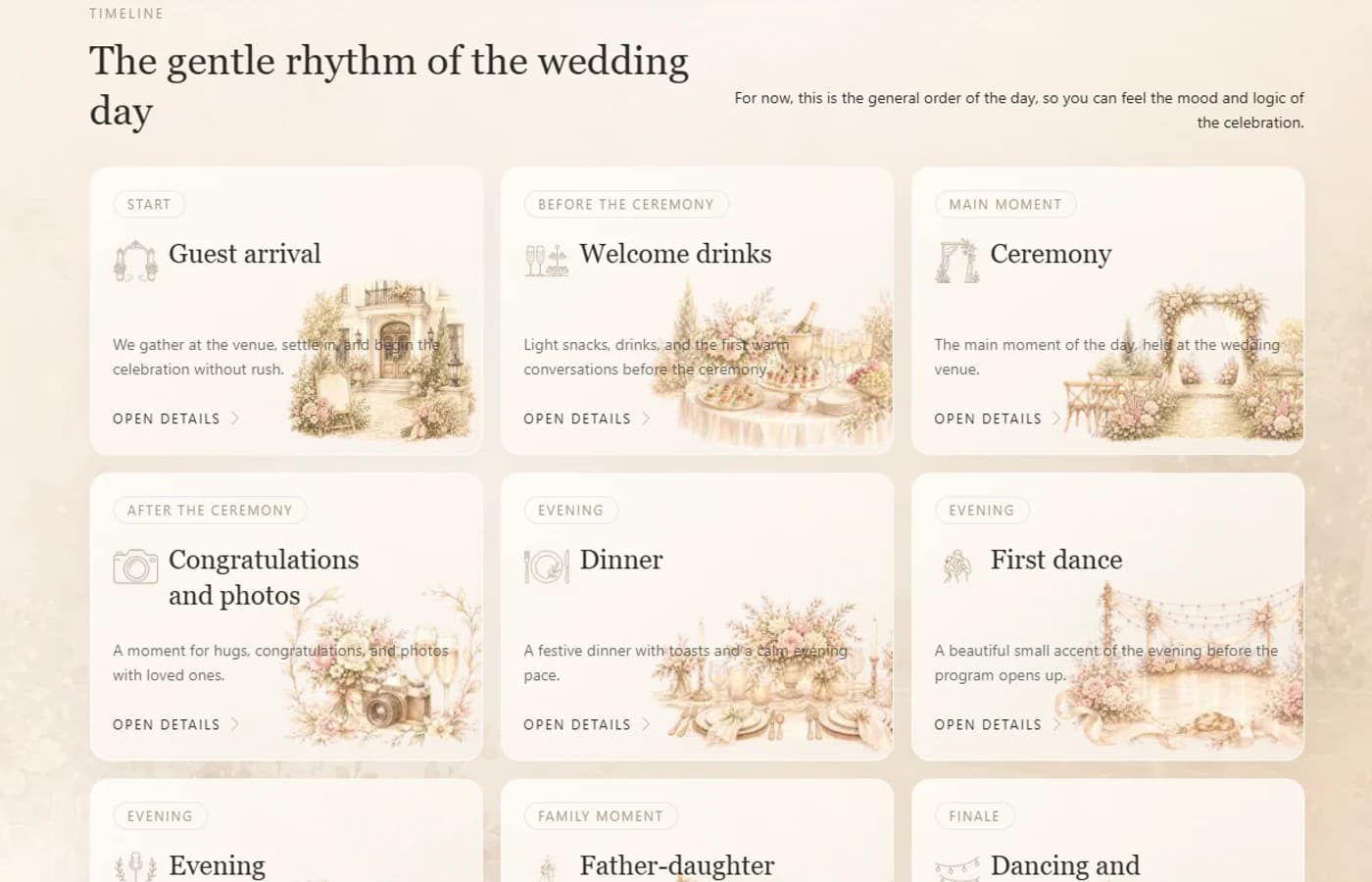
Wedding-day program cards in the guest interface03 · Day program
The real guest experience across desktop, mobile, and the day program — without personal data or invitation parameters.

Full Stack Platform

01

Wedding Invitation Platform

Personal invitations, RSVP, guest management, an administration interface, and integrations within one system.

Core features

  • Personal pages
  • RSVP
  • Guest management
  • Administration boundary
  • Integration workflows
  • Production deployment

Scope of responsibility

Product design, frontend, backend, data, integrations, and deployment.

  • Next.js
  • TypeScript
  • PostgreSQL
  • Tailwind CSS
  • Integrations
View case study

Operational Full Stack Platform

02

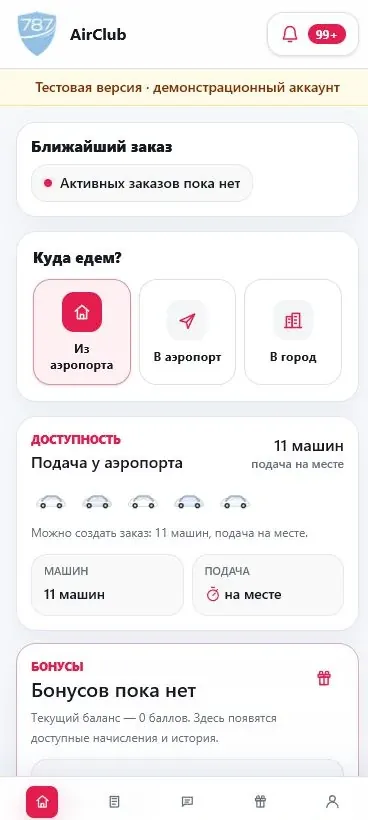
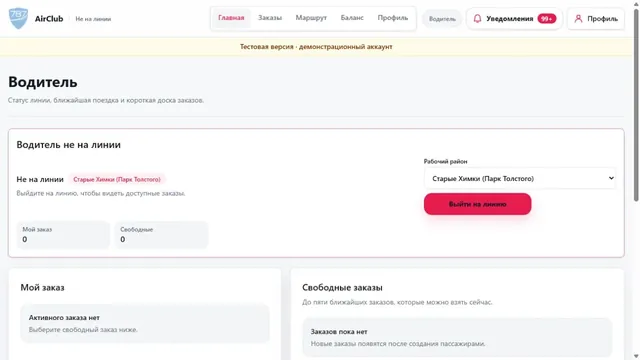
787 AirClub — Airport Transfer Operations Platform

Passenger, driver, dispatcher, and administration workflows for airport transfers within one web/PWA system.

Operational depth

Passenger · driver · dispatcher · administrator

Ride lifecycle, assignments, pricing rules, finance, and real-time operations.

  • Passenger and driver flows
  • Dispatcher and admin operations
  • Ride lifecycle and assignment
  • Zones and pricing rules
  • Finance ledger
  • Referrals and notifications
View case study
787 AirClub synthetic passenger interface
787 AirClub synthetic driver dashboard

Internal system

03

Shift & Workforce System

A workforce scheduling system for creating shifts, assigning employees, monitoring staffing coverage, and detecting schedule conflicts.

User
Manager / dispatcher
Result type
Operational control
  • Management UI
  • Assignment logic
  • Validation
  • Data

Detailed case study in preparation

Operational shift flowManager / dispatcher
  1. 01

    Shift creation

    Working period and parameters

  2. 02

    Required staffing

    Planned staffing need

  3. 03

    Employee assignment

    Employee-to-shift relation

  4. 04

    Conflict validation

    Schedule overlap checks

  5. 05

    Coverage status

    Textual staffing state

  6. 06

    Management view

    Operational status review

Planning tool

04

Meeting Calendar

A meeting scheduling service with server-side conflict validation, filtering, and persistent data storage.

User
Employee / coordinator
Result type
Working web application
  • Responsive UI
  • API
  • Validation
  • PostgreSQL

Detailed case study in preparation

Meeting validation and persistenceEmployee / coordinator
  1. 01

    Create meeting

    Participant and time range

  2. 02

    Validate time range

    Start and end validation

  3. 03

    Check conflicts

    Server-side validation

  4. 04

    Save data

    PostgreSQL through Prisma

  5. 05

    Filter and review

    Work with persisted records

05 · Professional profile

Ilya Flyantikov

Development and operations in one area of responsibility

I am a Full Stack developer with DevOps and infrastructure experience. I work across interfaces, server-side logic, data, integrations and production environments — from problem definition to launch and continued product development.

I am particularly interested in technical problems that require product thinking, backend logic, data and infrastructure to work as one system.
Download CV

Professional responsibility

  1. 01

    Product understanding

    Users, processes, constraints and the definition of a working outcome.

  2. 02

    Interface

    Clear user journeys and responsive implementation.

  3. 03

    Application logic

    Rules, states, roles, validation and server workflows.

  4. 04

    Data

    Models, relationships, integrity and controlled change.

  5. 05

    Integrations

    Connections to external services and communication channels.

  6. 06

    Infrastructure

    Runtime environments, servers, networking and operations.

  7. 07

    Delivery and support

    Verification, deployment, diagnostics and continued development.

Professional path

  1. 01Operations and responsibility
  2. 02Software development
  3. 03Full Stack systems
  4. 04Infrastructure and production
  5. 05Product ownership mindset

06 · Technology system

Technology choices follow the system architecture

Tools matter in context. They should match user flows, data requirements, integrations, operational constraints and the way a product will be maintained.

  1. 01

    Interface

    What users see and interact with.

    • React
    • Next.js
    • TypeScript
    • JavaScript
    • Tailwind CSS
    • responsive UI
    • PWA
  2. 02

    Application

    Server-side logic, permissions, calculations and business workflows.

    • Node.js
    • NestJS
    • REST API
    • Socket.IO
    • JWT
    • RBAC
    • validation
    • business workflows
  3. 03

    Data

    Storage, relationships, integrity and data processing.

    • PostgreSQL
    • Prisma
    • Redis
    • Neon
    • Supabase
    • migrations
    • data modelling
  4. 04

    Infrastructure

    The environment in which the system operates.

    • Linux
    • Docker
    • Docker Compose
    • Nginx
    • VPS
    • HTTPS
    • backups
    • monitoring
  5. 05

    Delivery

    How changes are validated and released to production.

    • Git
    • GitHub
    • GitHub Actions
    • CI/CD
    • Vercel
    • Render
    • build validation
    • deployment
    • diagnostics

07 · Ways to work together

Contribute at the right stage of the product lifecycle

We can start with a focused task, a new product launch or long-term technical ownership.

01

New product

An idea, MVP or internal system that needs to be designed and brought to a working release.

Entry point

  • A problem, idea or manual process
  • Users and constraints

Deliverable

  • Product structure
  • Interface, backend and data
  • Deployment and basic documentation

Continuation

  • Validate real workflows
  • Develop features and support operations
02

Focused feature

A new capability within an existing product: backend, API, roles, integration or a user workflow.

Entry point

  • A bounded scope
  • Context of the existing system

Deliverable

  • Implementation
  • Verification
  • Integration with the product

Continuation

  • Observe the change in use
  • Define the next scope
03

Technical correction

An issue in architecture, deployment, servers, data or the current development process.

Entry point

  • Diagnosis
  • A reproducible symptom and context

Deliverable

  • Confirmed root cause
  • Agreed correction
  • Verification and recommendations

Continuation

  • Reduce recurrence risk
  • Improve diagnostic workflows
04

Long-term work

A permanent role, technical partnership or continued product development over a longer horizon.

Entry point

  • Product goals
  • Current architecture and team

What the team receives

  • Architecture involvement
  • Consistent development
  • Technical responsibility

Continuation

  • Develop the roadmap
  • Support ongoing operations

Confidentiality

Confidentiality is part of engineering responsibility

Some commercial and internal projects cannot be published in full. I do not expose private source code, real user data or internal infrastructure, but selected interfaces and workflows can be demonstrated privately without disclosing confidential information.

Request a private walkthrough

08 · Contact

Have a product idea or a system to improve?

I can contribute to product design, implementation, launch or the continued development of an existing system.