02Operational Full Stack Platform

Operational flagship · AirCrew / 787 AirClub

787 AirClub — Airport Transfer Operations Platform

A web/PWA airport-transfer operations platform connecting passenger, driver, dispatcher, and administration workflows through explicit role boundaries.
  • Web/PWA
  • 4 role surfaces
  • Trip lifecycle
  • Operations
  • Production delivery

Project summary

Product
Airport transfer operations platform
Surfaces
Passenger · Driver · Dispatcher · Admin
Responsibility
Product, Full Stack, data, integrations, delivery
Case boundary
Public-safe · no production data

01 · Business problem

Connect self-service and operational control

Airport-transfer operations require more than an order form: the product needs separate permissions, lifecycle states, assignment rules, pricing references, notifications, and controlled exception handling.

  • Keep the passenger flow calm and free of internal operations terminology.
  • Show drivers only eligible available orders and their own work.
  • Give dispatch and administration clear exception visibility and reference-data controls.
  • Preserve lifecycle, finance snapshot, and audit integrity.

02 · User roles

Four separated product surfaces

Passenger

Creates orders and sees only their own rides, lifecycle states, and safe assignment details.

  • addresses
  • airport points
  • orders
  • notifications
  • referrals

Driver

Manages availability, accepts eligible work, and progresses an assigned ride.

  • availability
  • order board
  • assignment
  • trip progress
  • own finance

Dispatcher operations

Surfaces problem and waiting orders and supports bounded exception handling.

  • operations queue
  • assignment context
  • exceptions
  • notifications

Administrator

Controls users, drivers, zones, airport points, tariffs, and finance records.

  • RBAC
  • directories
  • tariffs
  • finance ledger
  • audit

03 · Passenger flow

Order without internal operations detail

Passenger flow

Passenger

  1. 01

    Direction

    To or from the airport

  2. 02

    Address and point

    Passenger-readable stops

  3. 03

    Time and party

    Date, time, passengers

  4. 04

    Create order

    Server validation and lifecycle

  5. 05

    Status

    Waiting, assigned, in progress

  6. 06

    Completion

    History and notifications

04 · Driver flow

Availability, assignment, and ride progress

Driver flow

Driver

  1. 01

    Availability

    Working state and zone

  2. 02

    Order board

    Eligible scope only

  3. 03

    Accept

    Assignment validation

  4. 04

    Pickup

    Allowed transition

  5. 05

    In progress

    Operational state

  6. 06

    Complete

    Finance snapshot and audit

05 · Dispatcher & admin

Operations, reference data, and exceptions

Normal work remains self-service. Dispatcher and administration surfaces provide visibility, configuration, and controlled exception handling.

  • problem and waiting order overview
  • driver assignment and release context
  • roles and access
  • zones and airport points
  • tariff rules
  • finance, reports, and audit trail

06 · Ride lifecycle

Controlled state transitions

User-facing states are derived from server order state, driver assignment, and audit events; the UI does not invent decorative lifecycle states.

Ride lifecycle

  1. 01

    Created

    Validated order

  2. 02

    Waiting for driver

    Available to eligible drivers

  3. 03

    Driver found

    Assignment confirmed

  4. 04

    Pickup

    Driver approaches

  5. 05

    In progress

    Active route

  6. 06

    Completed

    Final state and accounting

07 · Pricing & zones

Internal zones, clear passenger routes

Passengers choose an address and airport point. Zones remain internal units for matching, positioning, and tariff logic.

  • canonical zones and airport points
  • direction and passenger count
  • server-side price/quote contracts
  • admin-managed tariff rules
  • no unsupported prices in the UI
  • controlled manual correction workflow

08 · Finance model

Ride snapshots and an append-only ledger

The finance layer uses accepted ride snapshots and an append-only ledger instead of recalculating historical values in the interface.

  • fare, service commission, and driver income snapshots
  • personal/group/default commission source
  • reason-required manual adjustments
  • driver commission accrual/payment tracking
  • read-only reports and CSV
  • no acquiring, bank payout, or tax subsystem

09 · Architecture

Five connected platform layers

Separated role interfaces share application contracts, a relational model, and bounded integration adapters.

  1. 01

    Experience

    Passenger, driver, dispatcher, and admin interfaces.

    • Next.js
    • React
    • responsive PWA
    • role-aware states
  2. 02

    Application

    Orders, rides, roles, assignments, and transitions.

    • NestJS
    • REST API
    • RBAC
    • validation
    • Socket.IO
  3. 03

    Data

    Relational models, migrations, audit, and finance ledger.

    • PostgreSQL
    • Prisma
    • migrations
    • transactions
    • indexes
  4. 04

    Integrations

    Notifications, Telegram gateway, and provider boundaries.

    • webhooks
    • signed callbacks
    • realtime
    • provider adapters
  5. 05

    Delivery

    Build gates, release identity, and operational runbooks.

    • Docker
    • Linux
    • CI/CD
    • health checks
    • backups

10 · Infrastructure

Delivery and maintainable operations

Production delivery separates frontend, backend, and data responsibilities, verifies release identity, and maintains reproducible recovery steps.

  • Next.js frontend and NestJS backend
  • PostgreSQL/Prisma migrations
  • Docker/Linux runtime
  • HTTPS/reverse proxy boundary
  • CI gates and immutable build identity
  • live/ready health checks
  • monitoring, backups, and rollback documentation

11 · Responsibility

Product, Full Stack, and release engineering

My responsibility spans product workflows, full stack implementation, and evidence-led delivery.

  1. 01

    Product model

    Roles, user flows, truthful states, and MVP boundaries.

  2. 02

    Backend & data

    APIs, business rules, Prisma models, migrations, and audit.

  3. 03

    Role interfaces

    Passenger, driver, operations, and admin UX.

  4. 04

    Release engineering

    Tests, builds, smoke checks, deployment, and recovery evidence.

15 · Public interfaces

Role-specific product interfaces

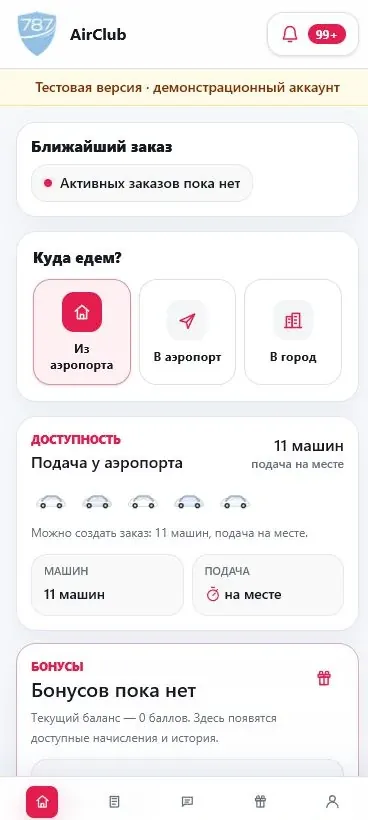
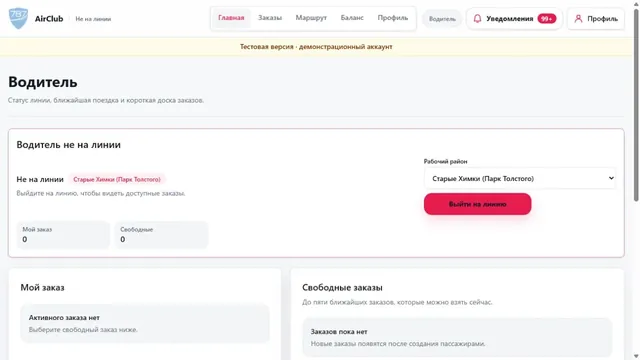
Screens from an explicitly marked demo environment. All values are synthetic; no production data was used.

04 · Privacy reviewed

Branded sign-in with no entered phone number or one-time code.
Passenger dashboard in an explicitly marked demo account; values are synthetic.
Driver empty state from the demo environment without passengers or rides.
Only the demo account aggregate overview; order identifiers and dates are excluded.

12 · Public boundary

What intentionally remains private

The public case explains the product without exposing operational data or sensitive configuration.

  • synthetic/demo screenshots only
  • no real passengers, drivers, or rides
  • no balances, invite/referral codes, or vehicle identifiers
  • no IPs, domains, credentials, logs, or secrets
  • no unverified metrics or fleet claims
  • security and deployment detail is generalized

Continue exploring the work